
Issues with representative boards | How we get to next | New piece on literary sector censorship out now in Griffith Review
Plus your chance to have a say on Australia's renewed national cultural policy, and more
Issues with representative boards
Should arts boards be made up of artists or cultural workers with direct experience of an organisation’s work? Or should we have more business people on boards to apply a corporate lens to how things ‘should be done’?
After my big rant about issues with government-appointed boards earlier this year, this month’s ‘and another thing’ vlog talks about the opposite: the more common ‘representative’ boards that elect, appoint or co-opt people based on demographics, skills or expertise.
Here’s an extract…
And you can find all links and credits on my website.
As usual, the full versions and archive of these rants are exclusively for my Patreon followers. If this series, enews, or any of my work has been of value to you, you can join me as an advocate, ally or accomplice from just $2.50/month. With huge thanks to Anne for joining my Patreon team this month.
How we get to next panel now online
In February this year, I joined Samuel Cairnduff, Nicholas Pickard and Sophie Lieberman on stage for ACMI’s FACT Symposium to talk about ‘how we get to next’ - including when it comes to how our arts, cultural and for-purpose organisations are governed.
“It’s important to acknowledge that our governance models and legislation were actually already unfit for purpose and are now woefully out of date. In the first place, they are built on capitalist and colonialist and military systems that are actually antithetical to most of our work, certainly within the for-purpose sector. And we’ve developed all of this learned practice around it that has created a gap between what we think we need to do, what our organisations need us to do, and what the legislation technically requires. Which means a lot of that learned practice that keeps us so busy is actually entirely optional.”
The video of our session is now available online.
Australia’s lost literary sector in Griffith Review
“Australia’s literary organisations were once bastions of new ideas, creative expression and open discourse. Our writers’ centres and festivals, literary journals and publishers, universities, training organisations, libraries and media outlets were trusted to record our history and imagine new possibilities. They nurtured and shared the work of writers and storytellers and supported a broad ecosystem of literary sector workers – administrators, agents, editors and publishers, teachers and academics, reviewers and journalists, illustrators, designers, marketers, booksellers, librarians, board members and more. But if this reads like a fairytale, it’s because the concept now seems almost fictional.”
My piece on Australia’s lost literary sector is in the latest edition of Griffith Review, talking about the astonishing censorship, harm and lateral violence coming from inside our own house. Read or subscribe from $6/month on the Griffith Review website.

April reading recs
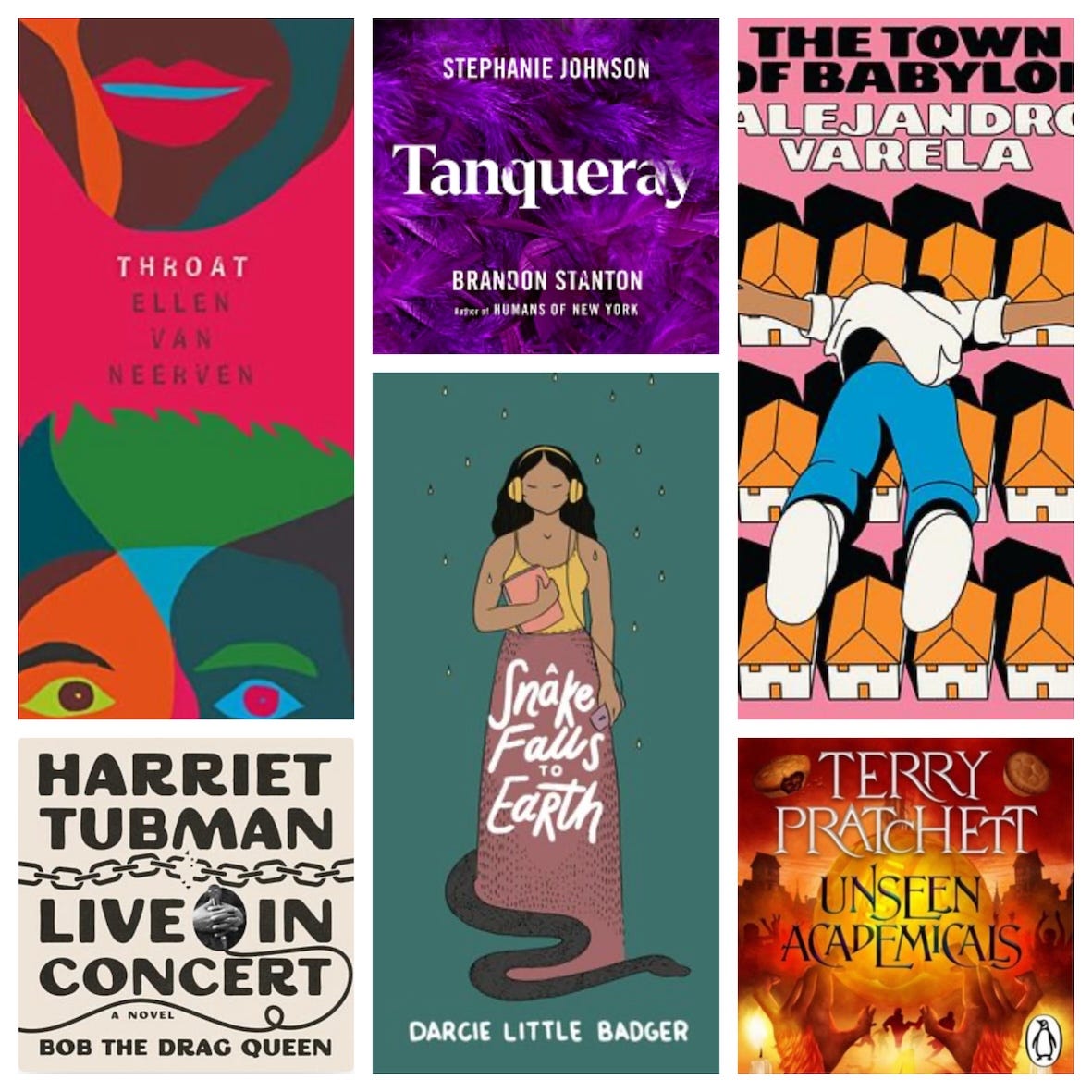
I read 11 books in April, bringing my reading year to 59 books in 2026 so far. My highlights were:
Throat by Ellen van Neerven, a witty, tender and powerful collection of First Nations poetry about queerness and blakness, love, land and resilience.
Harriet Tubman: Live in Concert by Bob the Drag Queen, a fabulous piece of contemporary speculative fiction about hip-hop, queerness, resistance, revolution and historical heroes coming back to life.
A Snake Falls to Earth by Darcie Little Badger, a clever weaving of contemporary YA climate fiction with Lipan Apache storytelling about crossing the lines between worlds.
The Town of Babylon by Alejandro Varela, an extraordinary debut of contemporary literary fiction about race and class, suburbia. secrets and sacrifice, and returning to first homes and first loves.
Tanqueray by Stephanie Johnson and Brandon Stanton, a wonderfully endearing memoir from the wild life of one of New York’s best known burlesque dancers.
And a re-read of Unseen Academicals by Terry Prachett, the perfect way to spend a 16-hour road trip, giggling my way through his fantastical adventure about football, racism and class.
Clever things I read on the internet this month include:
“A writer’s festival is, in many ways, an act of faith: faith that words still matter, that stories can still move people, and that a room full of strangers can gather in the dark and leave with some new understanding of themselves, each other, and the world they have inherited.”
The Starving Artist Trope Is a Policy Failure by Emil J Kang
“We call this the starving artist. We treat it as an identity, a trope, sometimes even a badge of honor. It’s none of those things. It’s a policy failure. We don’t say “starving teacher” or “starving nurse.” We don’t romanticise poverty in professions we’ve decided are essential. We only romanticise it where we’ve decided low compensation is culturally acceptable.”
“Waiting for the funding environment to change before acting is not a strategy. It is a way of running out of time.”
"One in four [Australian boards] identified “clear framework for reputation management” as an area needing improvement. The time to establish that framework is not when the crisis arrives."
“Often, ethical concerns are completely glossed over by AI experts, many of whom don’t mention them in their presentations. When they are brought up, I’ve seen a tendency for these concerns to be dismissed or there’s very little time that’s allocated to address them. As a sector that’s focused on creating a just and equitable world, we cannot ignore conversations like the above, in favour of a toxic and likely unfounded optimism about AI.”
(You can also read more on this topic in my recent raining on the parade of Generative AI in the arts).
“The defining word of Anthony Albanese’s leadership has been disappointment. Australians feel betrayed by a party who claim to fight for the working class, and a leader who refuses to do more than the bare minimum to improve our standing. But honestly, disappointment no longer feels like an appropriate descriptor.”
“As I write this, the War Minister Richard Marles is making a speech at the National Press Club calling for billions more in military spending. He’ll boast that we’ve exceeded our forecasted budget spend on weapons- fiscal responsibility is not important when it comes to our ability to kill people for our allies. Less than a week later, Mark Butler will get up at the same venue in front of the same audience to announce billions in cuts to the NDIS, and lament that we are exceeding the forecasted budget spend on ensuring disabled people can live empowered, dignified lives.
Inclusion must not be left to chance by Emma Bennison for DANA
“Until inclusion is genuinely baked into our communities, workplaces, transport systems and public spaces, we cannot pretend people with disability no longer need support.”
“Australia’s human rights record is being seriously eroded across a wide front. Our failures have been documented by the UN, Amnesty International, Human Rights Watch, and the Australian Human Rights Commission itself. The concerns are systemic and serious.”
How to Beat the Far Right: Lessons From History by Daniel Trilling in Zeteo
“If you want to speak out, to oppose the far right’s racism or the excuses people make for it, do it. Your voice is legitimate.”
Happy 40th Melbourne Writers Festival
I was proud to finally get to speak about Victoria Amelina’s extraordinary war and justice diary, Looking at Women Looking at War, with Maria Reva and Madison Griffiths at the 40th Melbourne Writers Festival this month.
It was such a sad privilege to sit alongside an empty chair to honour Victoria and grieve her loss. I cannot recommend her book highly enough.
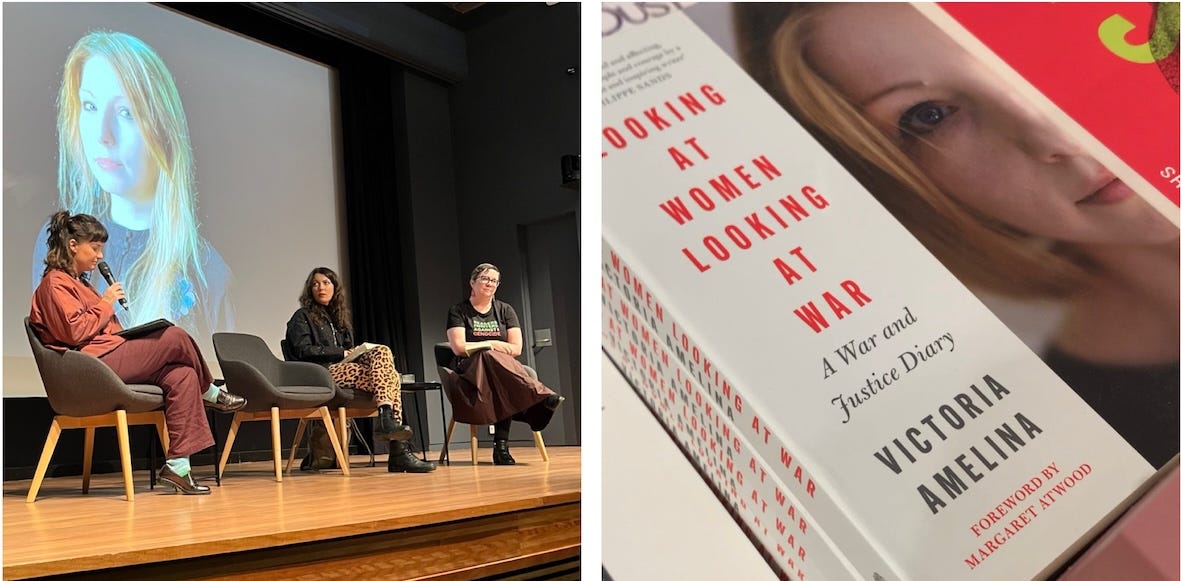
This conversation was originally programmed as part of last year’s Bendigo Writers Festival, so has been a long time coming. Huge thanks to Cecile Shanahan, David Ryding, Melbourne City of Literature Office, Lviv City of Literature, Veronica Sullivan, Victorian Women’s Trust, PEN Melbourne and Melbourne Writers Festival for making it happen - and to all who contributed to an extraordinary 40th year.
Have your say on the new national cultural policy by 24 May
ArtsHub has re-published my list of six critical strategies I think the sector should consider when creating its renewed national cultural policy.
“Unfortunately, one of the great ironies of Revive is that the sector currently has a full suite of state, territory and federal cultural policies in place for the first time and has never been more vulnerable. Well-meaning or performative policies intended to herald what Burke describes as the ‘restoration of culture to be at the centre of our national life’ have been accompanied by systemic deprioritisation of civic infrastructure in all areas.”
If you make or attend art, read Aussie books, enjoy Aussie music, watch Aussie-made films or TV, use libraries, visit museums or go to festivals etc., please have your say on Australia's renewed national cultural policy consultation.
You only need to write a few paragraphs, and you're welcome to use the following to help get you started:

Artists, cultural workers, audiences and allies can have your say by 24 May by:
Reading the public consultation paper (which is also available in Auslan and Easy Read).
Or uploading your own submission.
These don’t need to be as long or detailed as the draft I’ve shared below. In fact, ‘submissions can be simple,’ Penelope Benton and Nicole Beyer wrote in the lead-up to the last consultation – ideally no more than 3 pages. ‘You don’t need to articulate the value of the arts, or the economic benefits. This consultation is simply asking for what we need moving forward.’
Contacting 1800 248 025 or culturalpolicy@arts.gov.au to contribute in another format.